Universatis Kó:wa
Canine Service Institute
A structured, institute-grade training program for service, competition, and companion dogs, designed for families, handlers, and satellite trainers who want healthy, calm, reliable, and ethically trained dogs.
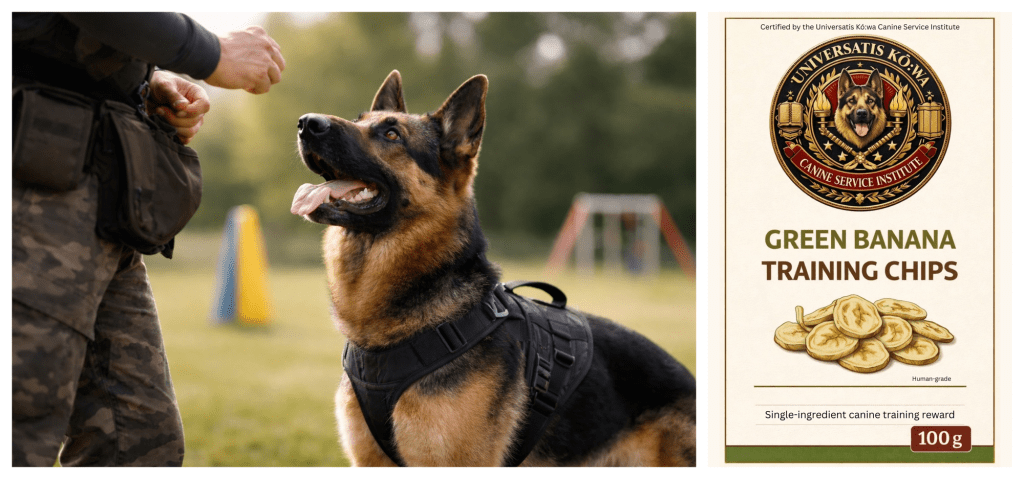
How the UKCSI curriculum is structured
The UKCSI canine training curriculum is built in progressive layers so that dogs and handlers can advance in a controlled, measurable way. Each stage has clear objectives, handler skills, and assessment checkpoints.
- Level 1: Foundation & Relationship
- Level 2: Control, Focus & Public Manners
- Level 3: Service & Support Tasks
- Level 4: Family & Integration
- Level 5: Maintenance & Review
Design principles
The curriculum is written to be:
- Evidence-aware — informed by modern behaviour science and positive reinforcement.
- Auditable — each skill has a description, criteria, and a way to test it.
- Exportable — suitable for at-home families and satellite trainers, not just central instructors.
- Ethical — no coercive or pain-based methods; emphasis on calm, predictable dogs.
Level 1: Foundation & Relationship
Level 1 establishes the basic language between dog and handler. The focus is on calmness, trust, and predictable responses in low-distraction environments.
- Handler presence, posture, and tone of voice.
- Name recognition and orientation to the handler.
- Marker word or signal and consistent follow-through.
- Core skills: sit, down, stay, recall (short distance), and loose-leash walking in quiet settings.
- Safe, structured greeting routines (no jumping, mouthing, or lunging).
Level 1: Handler skills and assessment
At Level 1, the curriculum expects handlers to:
- Use clear, consistent cues (no constant repetition or chatter).
- Recognize early signs of stress or overstimulation.
- End sessions before the dog is exhausted or frustrated.
- Log sessions briefly (time, environment, main exercises, observations).
Assessment at this level includes:
- A short handling test (on-leash, simple cues, low distraction).
- Observation of the dog’s default state around the handler (relaxed vs. hyper-alert).
- Review of a basic training log for consistency over time.
Level 2: Control, Focus & Public Manners
Level 2 extends the basics into environments with more noise, movement, and novelty. The aim is a dog that can stay connected to the handler even when the world is more interesting.
- Loose-leash walking with distractions (other dogs, people, sounds).
- Solid recall over longer distances and mild distractions.
- Settle on mat/place in busier environments (cafe, waiting room, training space).
- Doorway and threshold control (no pulling or bolting).
- Polite behaviour in public (no scavenging, minimal vocalisation).
Level 2: Handler skills and assessment
At Level 2, handlers are expected to:
- Plan sessions in slightly more challenging environments, not just at home.
- Manage their own stress and body language so they don’t transmit anxiety to the dog.
- Use distance and positioning to help the dog succeed around triggers.
Assessment includes:
- A practical walk test (with controlled distractions).
- A “settle” test in a semi-public setting (e.g., sitting quietly while the handler is seated).
- A recall test (coming when called away from mild interest).
Level 3: Service & Support Tasks
Level 3 is where the dog’s work becomes tailored to the handler’s needs. Not all dogs or teams will pursue Level 3; it is reserved for those moving into genuine service or structured support roles.
- Interrupting specific behaviours (e.g., nudging, leaning, or leading away).
- Retrieving items on cue (e.g., specific objects, dropped items).
- Guiding towards designated locations (exit, chair, quiet area).
- Practised response patterns during the handler’s distress or episodes.
Level 3: Customization and assessment
Level 3 is written with modular task “blocks” that can be combined based on the handler’s situation. Examples:
- A child who needs gentle interruption and grounding during overwhelm.
- An adult who benefits from repeated check-ins or nudges when dissociating.
- Structured fetching and carrying for mobility or fatigue-related support.
Assessment at this level looks at:
- Consistency of the specific support tasks (not just once, but repeatedly).
- Handler understanding of how and when to cue or allow the behaviour.
- Safety — the dog’s behaviour must never add risk in a vulnerable moment.
Level 4: Family & Integration
Level 4 focuses on long-term life with the dog: children, visitors, travel, and the everyday unpredictability of real households.
- Household rules: door behaviour, feeding routines, rest zones, and guest protocols.
- Children and vulnerable family members: supervised interaction patterns and clear boundaries.
- Travel: car safety, public transport etiquette, and overnight stays.
- Recovery after stressful events (startle, conflict, environmental shocks).
Level 4: Handler skills and assessment
By Level 4, handlers should be able to:
- Maintain routines even when tired or busy.
- Intervene early when behaviour drifts instead of waiting for a problem.
- Communicate expectations clearly to visitors, children, and other adults.
Assessment focuses less on set-piece tests and more on pattern stability:
- Is the dog’s behaviour predictable over weeks, not just during a single session?
- Does the household report fewer incidents, conflicts, or safety concerns?
Level 5: Maintenance & Review
Level 5 is about keeping what has been built. Skills fade if they are never used, and families change over time. Maintenance and review prevent quiet drift away from the standards.
- Periodic refreshers on recall, public manners, and core behaviours.
- Check-ins on household routines and changes (new family members, moves, school shifts).
- Review of any incidents, close calls, or pattern changes.
Level 5: Review options
Maintenance can be supported through:
- Short in-person refresh sessions at a UKCSI satellite.
- Remote review of video clips and training logs.
- Seasonal or annual check-ins, especially for dogs doing service or support work.
The goal is for the dog and handler to stay inside a safe, stable envelope over the long term, not just pass a one-time assessment.
Enrolment & delivery options
The UKCSI curriculum can be accessed in two main ways: as a guided at-home course for committed families and handlers, or through a satellite location working under the Universatis Kó:wa Canine Service Institute framework.
At-home curriculum package
A structured course designed for serious families and handlers who can follow written guidance and video demonstrations.
- Full written curriculum (Levels 1–5).
- Video demonstrations of key exercises.
- Simple logging / tracking templates.
- Options for remote review or add-on consultations.
Satellite & in-person courses
In-person training at approved locations working under UKCSI standards. Ideal for teams that need hands-on guidance or more complex service roles.
- Group classes or one-to-one sessions.
- Access to the same written curriculum used centrally.
- Option for joint sessions with families, children, and caregivers.
- Pathways to formal UKCSI assessment and recognition.
Choosing between at-home and satellite
In general:
- Families with strong self-discipline, time, and a stable home environment may do well with the at-home curriculum plus periodic remote support.
- Handlers working towards formal service roles, or families dealing with more complex needs, often benefit from satellite or in-person guidance.
It is also possible to start with the at-home course and move into satellite sessions later, or vice versa.
At-home course: placeholder
Replace this area with your chosen product or enrolment form for the at-home curriculum (e.g., WooCommerce product, enrolment form, or simple contact form requesting details).
Satellite / in-person training: placeholder
Replace this area with location details, a map, or a form for families and handlers to request information about the nearest UKCSI-aligned satellite training option.
 Universatis Kó:wa